What Are the Stages of a Sales Funnel?
Every customer journey begins somewhere, which could be from a Google search, a post on social media, a recommendation, or a visit to your website. Along the process, some people proceed while others drop out of the process.
The enrollment of students in schools works similarly. A parent can find your school via Google, visit your website, raise an inquiry, interact with a counselor, visit the school, and then decide whether to enroll his/her child in your school. Although it seems like one single journey, different decisions have been made along the way.
All the parents who raise an inquiry do not necessarily end up becoming students of your school; some may not even receive any follow-up after the inquiry, some may drop out during the campus visit, while others may go through fee comparisons with other schools and decide to attend other schools. If your sales team measures only enrolment, it becomes difficult to know where you lost the family.
This is where a sales funnel comes into play.
What Is a Sales Funnel?
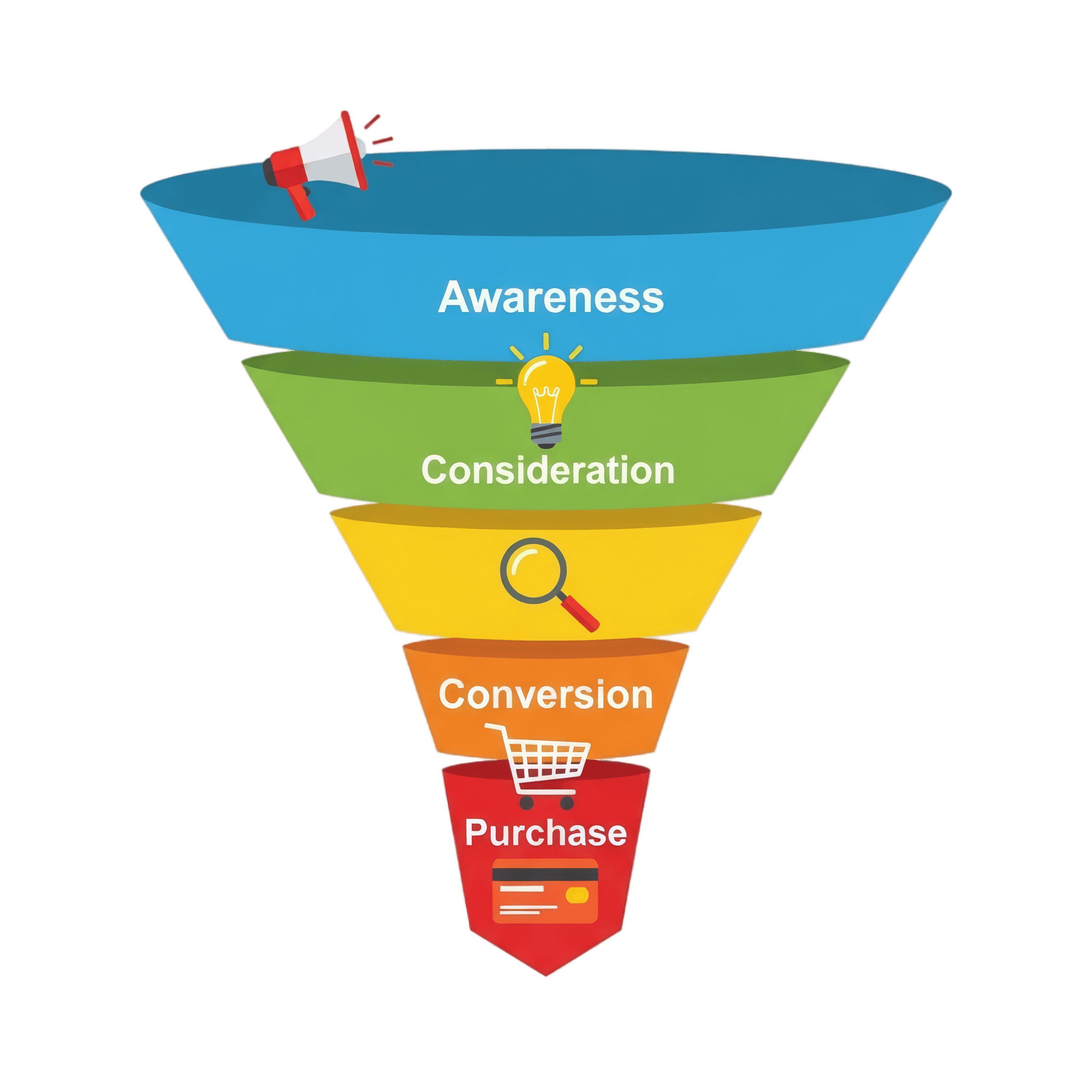
The sales funnel is a process that explains the path a potential client goes through before they make a decision. It is referred to as a sales funnel because while a lot of people join at the top, very few people go on to each next step.
The same can be applied in school admissions. A school might contact a lot of people through different channels like search engines, social networks, advertising, events, and even referrals. However, out of them only a few will ask about the school; some will come to see the school, even fewer will apply, and very few will actually register at the school. This will help admission officers understand the process.
The process becomes even more personal as parents are selecting an environment where their children will spend the next couple of years; thus, all aspects of academic life, security, quality of education, facilities, fees, location, and trust play a major role.
Why Does the School Admissions Funnel Matter?
The school receives 1,000 inquiries during an admission season, but admits only 80 pupils. The question that emerges at first is: what happened to the remaining 920?
Did they not receive any follow-up at all? Did they come to the school but got uninterested further? Did they start an inquiry but not finish it? Without a proper funnel, it is hard to say for sure.
By using a funnel, the school will be able to understand how families go through each step of the process and find out where they lose their interest. It will help the school address its real problems and not invest additional resources into attracting more inquiries.
What Are the Stages of a Sales Funnel for School Admissions?
The traditional funnel consists of Awareness, Interest, Desire or Evaluation, and Action. In a school context, it is good to extend this up to the point where the student becomes a part of the school community:
Awareness → Interest → Evaluation → Action → Retention and Advocacy
Each of the steps corresponds to a certain parent mentality and requires a certain action on the part of the school.
1. Awareness: The Parent Becomes Aware of Your School
The awareness stage takes place before any contact with you is made and involves discovering the school via a search engine, a social network entry, a recommendation from a friend, or even a hoarding. Here, the aim is simply for the parent to gain an impression, and the key factors here will be visibility and credibility. An informative website, positive reviews, social media activity, and academic information should be considered.
2. Interest: The Parent Places an Enquiry
The interest stage occurs when a parent takes action by filling out a form, calling, messaging on WhatsApp, or inquiring about seating. The parents usually want information about fees, curriculum, transport or the admissions procedure. Since the parents usually contact more than one institution, a quick response is helpful, but "Thanks for your enquiry" does not suffice. The response from the counselor who knows the needs of the parent will help build the relationship, and here the importance of a sales process comes into play.
3. Evaluation: The Parents Compare and Evaluate
The parents will be comparing your institution with other institutions in terms of visits to the campus, open days, meetings with the principal/counselor, demo class, and meeting with current parents. The questions become very personal: is this suitable for my child? Are the teachers friendly? Is the cost justified? A hasty or poorly organised campus visit may undo any online effort.
4. Action: The Parent Applies and Enrolls
Consideration has now translated into action as the parent applies, submits the papers, completes the assessment process, and makes the payment. Since the parent has already made up his or her mind, it may only take minor things like complex forms, confusing document requests, payment problems, or lack of communication to lose out on securing this admission.
5. Retention and Advocacy: The Relationship Continues
This is not the point at which the funnel ends after you get the admission fee. Successful onboarding, follow-up communication, and a good start ensure that the parent feels good about the choice and becomes your best new enrollment source because of personal recommendations.
Where Do Schools Lose Admission Enquiries?
Not the lack of inquiries but what follows their arrival that is the challenge faced by many schools.
A delay in following up on inquiries is very common. The parent who has just expressed an interest in joining your institution will most likely be considering other schools as well, and the chance may slip away before the communication begins. An inconsistent follow-up can be an even bigger problem because parents sometimes require some time to compare fees or consult with their families, and a school that makes only one call and does not follow up any further will simply be forgotten.
Lack of proper information is yet another problem. The inquiry could come from the website, a phone call, WhatsApp, social media, walking into the school or even by referral. When such inquiries are kept separately on spreadsheets, notebooks, and even in one’s mobile phones, it becomes difficult to get the complete parent journey.
Campus visits can be a drop-off point when a parent leaves the institution with no clear answers or action plans, and an unnecessarily lengthy and complicated application form may sabotage weeks of counseling.
How Do Sales Process Steps Work in School Admissions?
The funnel is meant to represent the process the parent goes through, while the steps of the sales process refer to how this process is managed by the admissions team. The sales process should cover all enquiries, no matter where they come from, qualify them, distribute them to the right counselor, reach out, and proceed through follow-up, to campus visits, counseling, application, and finally enrollment.
The key point is the consistency of the process. If one counselor makes five follow-ups, another just one, and the third never records the conversation at all, the results will be dependent upon how well the counselor does his job individually. The process makes all do the same, but also leaves the possibility of a proper conversation with the parent.
Building a Sales Plan for the Admissions Funnel
The sales strategy is what converts the funnel to an actual strategy. Instead of aiming at such broad targets as "generate 500 enquiries," a school can begin with the number of seats it has to fill and then figure out how many applications, visits, qualified enquiries, and enquiries it will need to generate.
The sales strategy can help schools decide where to put their marketing money too. A marketing channel that generates hundreds of enquiries but very few admissions can actually be less effective than the one that brings less enquiries but has better conversions. The weekly funnel analysis conducted during peak seasons helps schools catch any changes in the quality of the enquiries, timing of the responses, visits, or conversions of applications.
What Is Sales Territory in Sales Management for Schools?
Sales territory may seem like something that is more applicable to salespeople rather than schools, but the concept is still valid for institutions in the education field. Sales territory refers to the area/segment assigned to the salesperson or the sales team. In the case of a school, the territory can be created according to geographical locations, pin codes, feeder schools, grade levels, source of leads, or a specific community of people.
It is very beneficial for institutions operating out of several campuses and having a large catchment area. In case the inquiries are coming from three different geographical locations, then the team can analyze them separately – one location can generate lots of volume with good conversion, whereas another location can have lots of interest with no visits at all. When the admissions are analyzed geographically, some opportunities that cannot be found otherwise become obvious.
How Can Schools Improve Their Admissions Funnel?
Improvement of the funnel need not necessarily mean the generation of new leads; the best possibility is usually within the funnel. Identify the stage that sees a maximum fall-off and address it – work on the counseling and follow-up processes if there are very few conversions from inquiries to visits or from visits to applications. Centralize all of the inquiries into one database, automate communication so that counselors can engage in personal discussions, make admissions information easily accessible through the website, and analyze the number of contacted, visited, applied, and enrolled inquiries periodically.
The Final Takeaway
An effective admissions funnel has nothing to do with seeking out new enquiries, but more to do with supporting the right families through each step. Respond promptly, maintain consistent follow-up, give an engaging experience on campus, streamline the application process, and analyze your funnel to understand where the families are falling out. First, map out your current journey, and now you have a process for conversion rather than a list of leads.
A well-run admissions funnel enables a school to convert more enquiries into visits, applications, and enrolment. With joinether, you bring together enquiries, follow-ups, parent interactions, and conversions onto one well-organized platform.

Related articles
Oct 10, 2026
CRM Full Form in Business: Meaning, How It Works & Top Tools

Sep 18, 2026
How does library management system work?

Sep 18, 2026
What Is IQAC? Importance and Benefits Of IQAC In NAAC