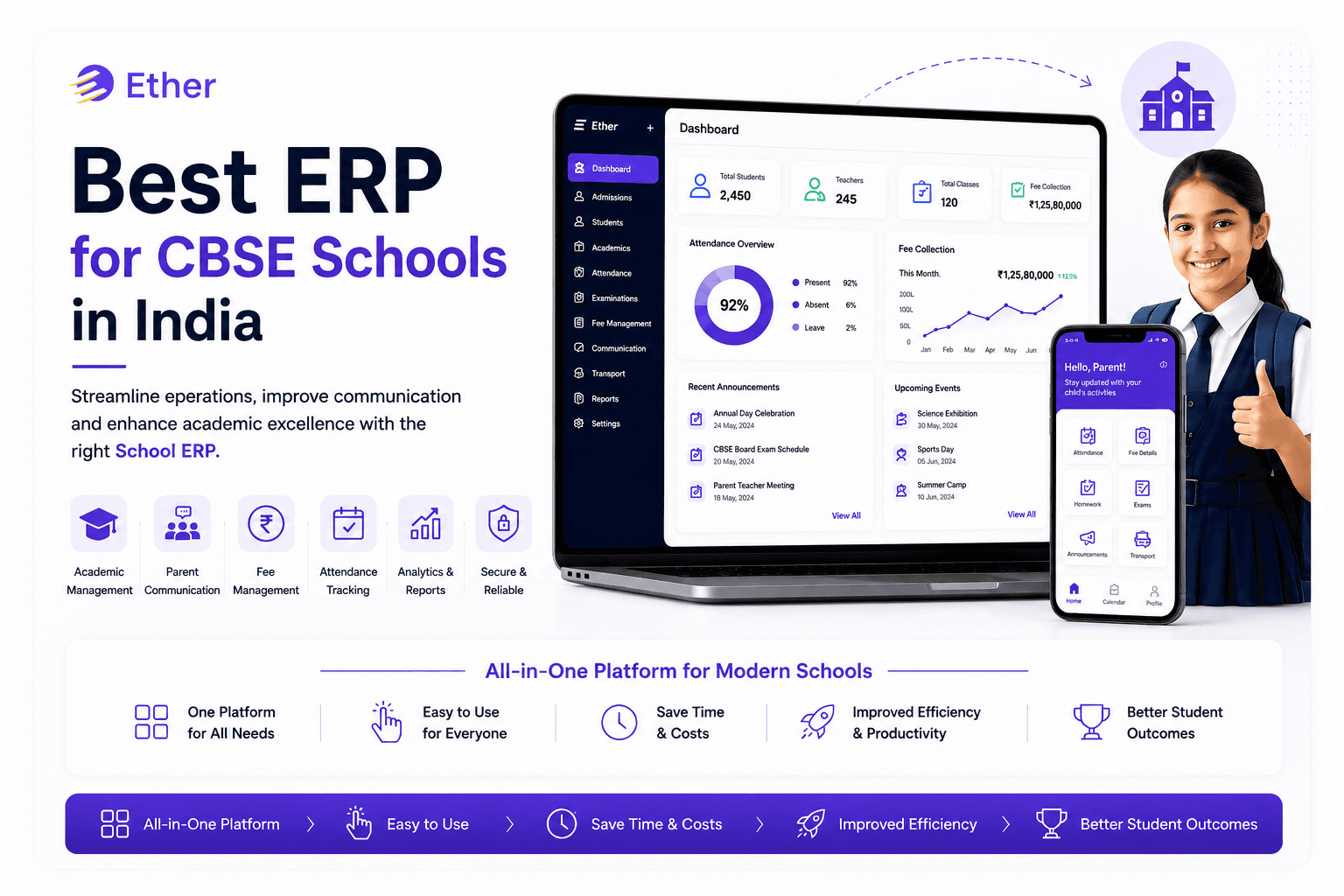
The Indian education system is changing fast, especially after the new education policy was introduced in 2020, and the demand for digital transformation in schools is growing. Schools that follow the CBSE curricula need efficient systems to manage their work, such as communication, administrative, and academic processes. This is where School ERP systems in India come in.
A School ERP, put simply, is a centralized platform that brings together multiple school functions like parent communication, examinations, fees, attendance, and admissions into one dashboard. Instead of doing things manually, schools can use ERP solutions to make their work easier and faster.
In this article, we will talk about ERP for CBSE schools in India, what features to look for, and why some platforms like Ether, Fedena, and others are becoming popular among modern schools.
What is a School ERP System?
It is cloud-based software that automates as well as manages different school-related activities. This system links various departments-communication, finance, academics, and administration into a single unified system.
With compliance requirements, parent expectations, and increasing student data, manual processes no longer remain sustainable. An ERP system supports schools:
Improve transparency Reduce paperwork
Improve communication between stakeholders.
Save operational costs and time.
Why CBSE Schools in India Need ERP Software?
CBSE schools have a structured curriculum and need efficient communication systems, continuous assessment tracking, and accurate record-keeping. ERP software supports them in meeting such needs effectively.
Easy Administration- an ERP system automates admissions, staff management, and student records, decreasing manual workload.
Academic Tracking-an ERP platform, manages report cards, exams, assignments, and timetables aligned with the CBSE guideline.
Efficient Fee Management-CBSE schools can collect fees online using net banking, cards, and UPI, with reminders and automated receipts.
Real-Time Communication- parents receive immediate updates on results, homework, and attendance through notifications and mobile apps.
Data-Driven Decisions-advanced analytics support school leaders monitor performance and enhance outcomes.
What are the Key Features to Consider in an ERP System?
When selecting ERP for CBSE schools, consider these crucial features:
Admission Management- an online form, documentation uploads, and an automated enrollment process simplifies admissions.
Report Cards & Examination-customizable report card and a grading system aligned with CBSE standards.
Attendance Tracking: Mobile-first attendance with real-time parent notifications.
Fee Management- payment reminders, financial reporting, and automated billing.
Parent-Teacher Communication-WhatsApp, SMS, and mobile apps for seamless communication.
Analytics and Reporting- artificial intelligence-driven insights for operational efficiency and academic performance.
What are the Best ERPs for CBSE Schools in India?
Let’s highlight the best ERP for CBSE schools,
Ether
Ether is the only school operating system in India that brings ERP and admissions CRM together in a single operating system - built by educators who understand how Indian schools actually function.
For CBSE schools, this means:
Ether Enrol manages the full admissions pipeline - enquiry capture, lead tracking, automated WhatsApp / SMS / email follow-ups, AI call audits, and merit list generation.
Ether EasyPay handles online and offline fee collection with concessions, late fees, refunds, and instant digital receipts.
Ether Ecole structures parent-staff communication with AI moderation and two-way engagement.
Ether Edgility MIS gives leadership a real-time view of attendance, fees, occupancy, and academic performance.
Why Ether?
Where most platforms treat CRM as an add-on module, Ether Enrol is a full-featured admissions CRM in its own right. There’s no extensive training required, no dedicated IT team needed, and the platform is built specifically for the daily operational realities of running an Indian school. For CBSE institutions focused on admissions growth and parent experience without adding operational complexity, Ether is a natural fit.
VAPS Group
This is a perfect choice for complete school management, holding decades of expertise in the education technology space. VAPS Group offers effective ERP solutions designed for CBSE and other educational institutions, thus ensuring seamless administrative and academic workflows.
Key Features
All-inclusive school management system
Long-standing industry experience
Reliable reporting tools and data management
Customizable modules for diverse school needs
Strong academic and administrative integration
Why VAPS Group?
It stands out for its deep understanding and proven track record of school operations. VAPS’s experience-driven approach ensures stability and reliability, making it appropriate for schools seeking a well-established ERP system.
Vidyalaya ERP
It provides school management solutions that are end-to-end, created to digitize and streamline all aspects of school operations. Vidyalaya is highly acknowledged for its smooth integration capabilities and advanced features.
Key Features
Cloud-based access & reporting
Finance and fee management
Comprehensive teacher-parent communication portal
Online assessment and e-exam tools
Biometric attendance system
Why Vidyalaya?
It is a strong pick for schools wanting a comprehensive digital ecosystem. Vidyalaya’s ability of integrating several functions into one platform makes it extremely efficient for enhancing operational transparency and communication.
Edunext Technologies
This is known for its innovative approach to school ERPs, especially its special “Talking ERP” feature that allows voice command functionality.
Key Features
Advanced reporting & analytics
Real-time communication tools
Smart finance and fee management
Cloud-based admission & academic planning
Talking ERP equipped with voice command capabilities
Why Edunext?
It stands out due to its user-friendly design and innovation. Edunext’s voice-enabled ERP adds convenience, thus making it simpler for users to interact with this system, particularly for quick tasks and updates.
Entab (CampusCare)
This is popular for its enterprise-grade, advanced ERP solution made for premium and large schools. Entab provides a modular approach that supports multi-campus operations and scalability.
Key Features
Secure cloud-based system
Comprehensive academic & administrative tools
Advanced analytics & reporting
Multi-campus management support
Scalable and modular ERP architecture
Why Entab?
It is appropriate for big institutions that need a scalable and powerful ERP. Entab’s flexibility and enterprise-level features make it ideal for efficiently handling complex school structures.
Fedena
This is a universally acknowledged school ERP in India known for its cost-effectiveness and flexibility. Fedena provides an open architecture system that has extensive customization options.
Key Features
Multi-branch support
Examination + grading systems
Student lifecycle management
Open architecture for customization
50+ integrated module
Why Fedena?
It is ideal for schools that require a budget-friendly and customizable ERP solution. Fedena’s flexibility allows schools to customize the platform as per their precise requirements and specific workflows.
Scool360
This is a contemporary, cloud-based ERP system made for educational institutions aiming for digital transformation. Scool360 is especially appropriate for mid-sized schools seeking a mobile-first solution.
Key Features
Easy integration with educational institution processes
Administrative and academic management
Digital communication tools
Cloud-based accessibility
Mobile-friendly interface
Why Scool360?
It stands out due to its mobility and simplicity. Scool360 is perfect for schools seeking an effective ERP system to transition seamlessly into digital operations.
What are the Benefits of Implementing ERP in CBSE Schools?
Improved Learning Outcomes- with improved analytics and tracking, schools can enhance student performance.
· Cost & Time Savings- less manual work and less paperwork result in cost savings.
· Accuracy & Transparency- digital records decrease errors and ensure data accuracy.
· Better Communication- an ERP system bridges the gap between teachers, administrators, and parents.
· Better Efficiency- automation cuts down repetitive tasks and enables staff to emphasize on core activities.
How to Select the Right ERP for your CBSE School?
Selecting an appropriate school ERP in India for CBSE schools depends on one’s school’s size, needs, and precise budget. Let’s highlight a few tips,
· Select scalable solutions that grow with the school.
· Look for favorable customer support.
· Check for CBSE curriculum compliance features.
· Ensure mobile application availability.
· Opt for a cloud-based solution for seamless access.
· Identify the key needs (academics, fees, communication, etc.)
Takeaway
Choosing the right ERP for CBSE schools in India is no longer optional — it’s foundational to staying competitive in the digital education landscape. From academic tracking to admissions and communication, the right platform shapes how an institution operates day to day.
For CBSE schools that want a modern, all-in-one platform built by educators - one that combines a true admissions CRM with operational ERP without requiring extensive training or IT support - Ether stands out as the strongest choice. For schools with deep operational requirements like inventory, hostel, or payroll management, traditional ERPs like Vidyalaya, Entab, or Fedena offer specialised modules.
Ultimately, the right platform depends on the school’s priorities - but for institutions focused on admissions growth, parent engagement, and ease of adoption; Ether is purpose-built for the job.
Explore More Articles:

Related articles
Oct 17, 2026
K-12 Digital Transformation in 2026: Trends and Best Practices

Oct 10, 2026
What Are the Stages of a School Admission Funnel? A Complete Guide
Oct 10, 2026
CRM Full Form in Business: Meaning, How It Works & Top Tools